
 Posted By
Bajarangi soft ,
Posted On 08-10-2020
Posted By
Bajarangi soft ,
Posted On 08-10-2020
Object Syntax
{"name":"John", "age":30, "car":null}
JSON objects are surrounded by curly braces {}.
JSON objects are written in key/value pairs.
Keys must be strings, and values must be a valid JSON data type (string, number, object, array, boolean or null).
Keys and values are separated by a colon.
Each key/value pair is separated by a comma.
Accessing Object Values
You can access the object values by using dot (.) notation:
Example(1)
myObj = { "name":"John", "age":30, "car":null };
x = myObj.name;
You can also access the object values by using bracket ([]) notation:
myObj = { "name":"John", "age":30, "car":null };
x = myObj["name"];
Looping an Object
You can loop through object properties by using the for-in loop:
myObj = { "name":"John", "age":30, "car":null };
for (x in myObj) {
document.getElementById("demo").innerHTML += x;
}
In a for-in loop, use the bracket notation to access the property values:
myObj = { "name":"John", "age":30, "car":null };
for (x in myObj) {
    document.getElementById("demo").innerHTML += myObj[x];
}
Nested JSON Objects
Values in a JSON object can be another JSON object.
myObj = {
  "name":"John",
  "age":30,
  "cars": {
    "car1":"Ford",
    "car2":"BMW",
    "car3":"Fiat"
  }
 }
You can access nested JSON objects by using the dot notation or bracket notation:
x = myObj.cars.car2;
// or:
x = myObj.cars["car2"];
You can use the dot notation to modify any value in a JSON object:
myObj.cars.car2 = "Mercedes";
You can also use the bracket notation to modify a value in a JSON object:
myObj.cars["car2"] = "Mercedes";
Delete Object Properties
Use the delete keyword to delete properties from a JSON object:
delete myObj.cars.car2;
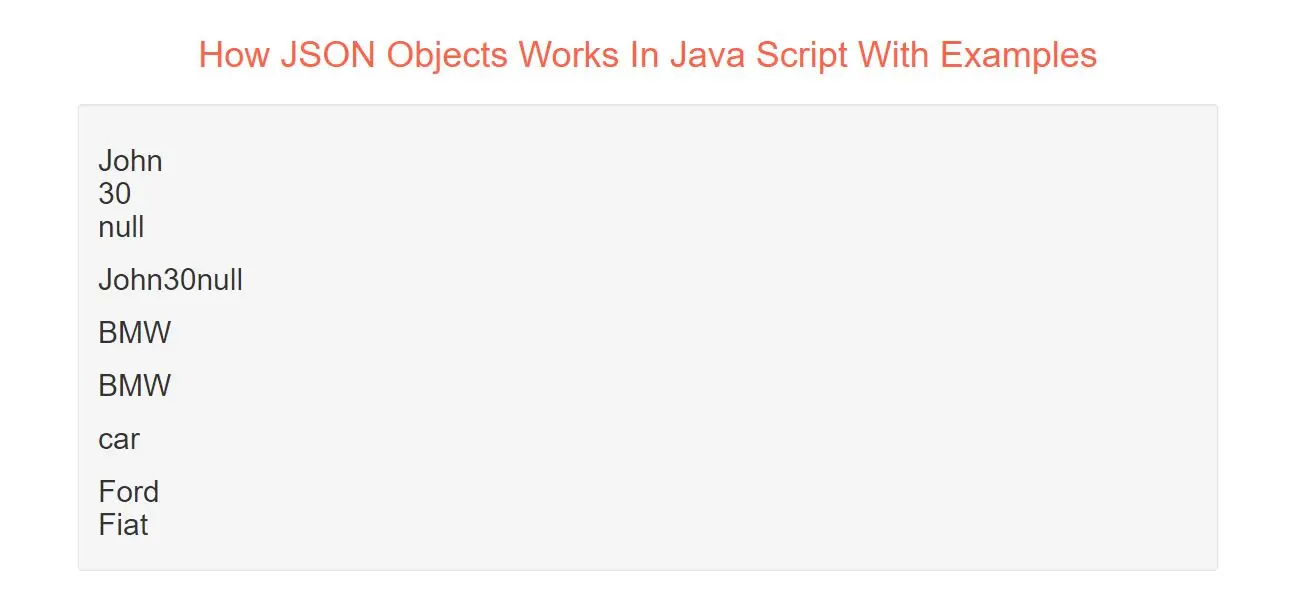
Complete Code For JSON Objects Works In Java Script With Examples
<!DOCTYPE html>
<html>
<head>
    <title>How JSON Objects Works In Java Script With Examples</title>
    <meta charset="utf-8">
    <meta name="viewport" content="width=device-width, initial-scale=1">
    <link rel="stylesheet" href="https://maxcdn.bootstrapcdn.com/bootstrap/3.4.1/css/bootstrap.min.css">
</head>

<body>
<div class="container">
    <br>
    <div class="text-center">
        <h1 id="color" style="color: tomato">How JSON Objects Works In Java Script With Examples</h1>
    </div>
    <br>
    <div class="well">
        <h2 id="demo1"></h2>
        <h2 id="demo2"></h2>
        <h2 id="demo3"></h2>
        <h2 id="demo4"></h2>
        <h2 id="demo5"></h2>
        <h2 id="demo6"></h2>
    </div>

    <script>
        var myObj, x;
        myObj = {"name":"John", "age":30, "car":null};
        for (x in myObj) {
            document.getElementById("demo1").innerHTML += myObj[x] + "<br>";
        }

        myObj2 = { "name":"John", "age":30, "car":null };
        for (x in myObj2) {
            document.getElementById("demo2").innerHTML += myObj2[x];
        }

        var myObj3 = {
            "name":"John",
            "age":30,
            "cars": {
                "car1":"Ford",
                "car2":"BMW",
                "car3":"Fiat"
            }
        }
        document.getElementById("demo3").innerHTML += myObj3.cars.car2 + "<br>";
        //or:
        document.getElementById("demo4").innerHTML += myObj3.cars["car2"];

        var myObj4, i, x4 = "";
        myObj4 = {
            "name":"John",
            "age":30,
            "cars": {
                "car1":"Ford",
                "car2":"BMW",
                "car3":"Fiat"
            }
        }
        myObj4.cars.car2 = "Mercedes";

        for (i in myObj4.cars) {
            x4 += myObj4.cars[i] + "<br>";
        }

        document.getElementById("demo5").innerHTML = x;

        var myObj5, i5, x5 = "";
        myObj5 = {
            "name":"John",
            "age":30,
            "cars": {
                "car1":"Ford",
                "car2":"BMW",
                "car3":"Fiat"
            }
        }
        delete myObj5.cars.car2;

        for (i in myObj5.cars) {
            x5 += myObj5.cars[i] + "<br>";
        }

        document.getElementById("demo6").innerHTML = x5;
    </script>
</div>
</body>
</html>