
 Posted By
Bajarangi soft ,
Posted On 16-10-2020
Posted By
Bajarangi soft ,
Posted On 16-10-2020
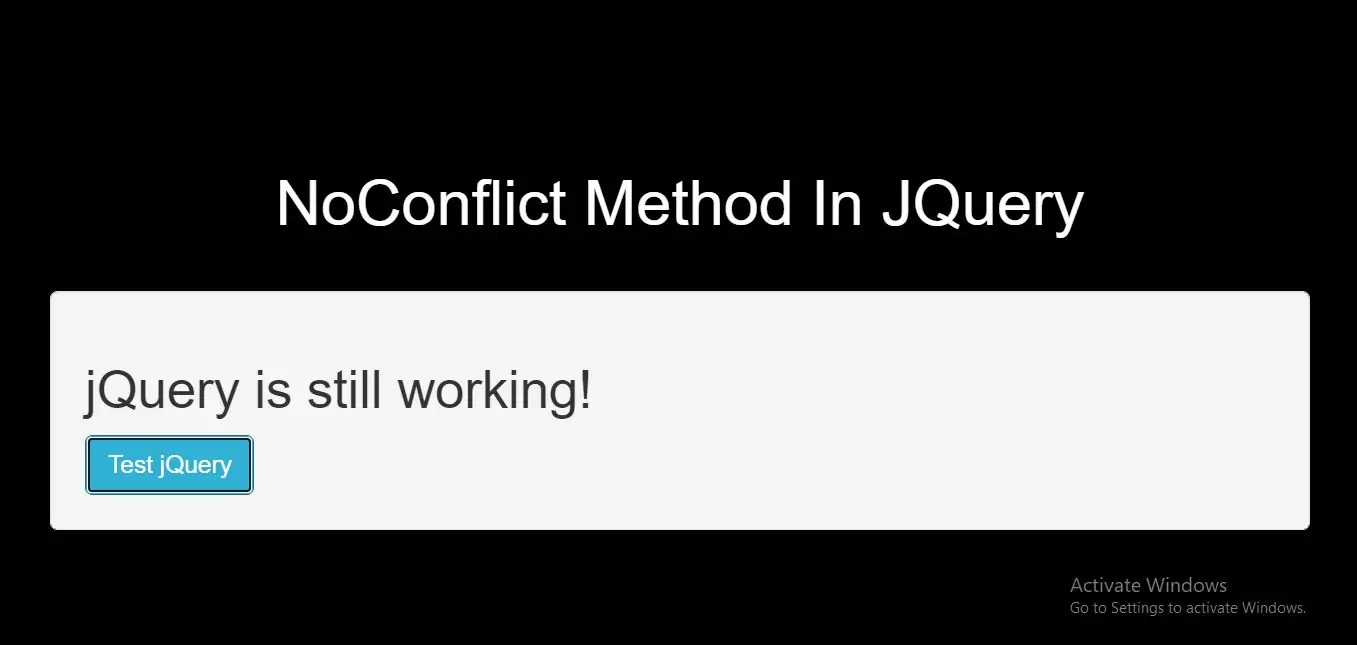
You can of course still use jQuery, simply by writing the full name instead of the shortcut:
Example(1)
<script>
$.noConflict();
jQuery(document).ready(function(){
    jQuery("button").click(function(){
        jQuery("p").text("jQuery is still working!");
    });
});
</script>
noConflict() method returns a reference to jQuery, that you can save in a variable, for later use. Here is an example:
<script>
var jq = $.noConflict();
jq(document).ready(function(){
    jq("button").click(function(){
        jq("p").text("jQuery is still working!");
    });
});
</script>
$ shortcut and you do not want to change it all, you can pass the $ sign in as a parameter to the ready method. This allows you to access jQuery using $, inside this function - outside of it, you will have to use "jQuery":
$.noConflict();
jQuery(document).ready(function($){
    $("button").click(function(){
        $("p").text("jQuery is still working!");
    });
});
<!DOCTYPE html>
<html>
<head>
    <title>How To Use NoConflict Method In JQuery With Example</title>
    <meta charset="utf-8">
    <meta name="viewport" content="width=device-width, initial-scale=1">
    <link rel="stylesheet" href="https://maxcdn.bootstrapcdn.com/bootstrap/3.4.1/css/bootstrap.min.css">
    <script src="https://ajax.googleapis.com/ajax/libs/jquery/3.5.1/jquery.min.js"></script>
</head>
<style>
    body {
        background: black;
    }
</style>
<body>
<div class="container">
    <br><br><br><br>
    <div class="text-center">
        <h2 id="color" style="color: White;">NoConflict Method In JQuery</h2>
    </div>
    <br>

    <div class="well">
        <h2>This is a paragraph.</h2>
        <button class="btn btn-info">Test jQuery</button>
    </div>

</div>
</body>
</html>

<script>
    $.noConflict();
    jQuery(document).ready(function($){
        $("button").click(function(){
            $("h2").text("jQuery is still working!");
        });
    });
</script>